English
 français
 Deutsch
 Español
 italiano
 русский
 português
 中文
中文
×
When industrial digital transformation moves from concept to frontline production, intelligent hardware is no longer an lofty technical term, but a "digital infrastructure" permeating every specific scenario, including workshop equipment control, outdoor engineering inspection, and logistics warehousing inventory. According to VDC Research, the annual failure rate of consumer-grade devices in industrial environments exceeds 38%, while the failure rate of professional industrial intelligent hardware is only 4%. This set of data directly reveals the importance of adaptability: choosing the right hardware can lay a solid foundation for stable operation of enterprises, while choosing the wrong one may become an "invisible stumbling block" in the digital process.
As a national high-tech enterprise with 14 years of deep cultivation in the field of industrial intelligent hardware, Dehang Intelligent (Geshem) accurately matches the core needs of different industrial scenarios with 92 patented technologies and a full-category product layout. Next, starting from scenario requirements, we will analyze the selection logic of industrial intelligent hardware and provide feasible references for enterprises' digital transformation.
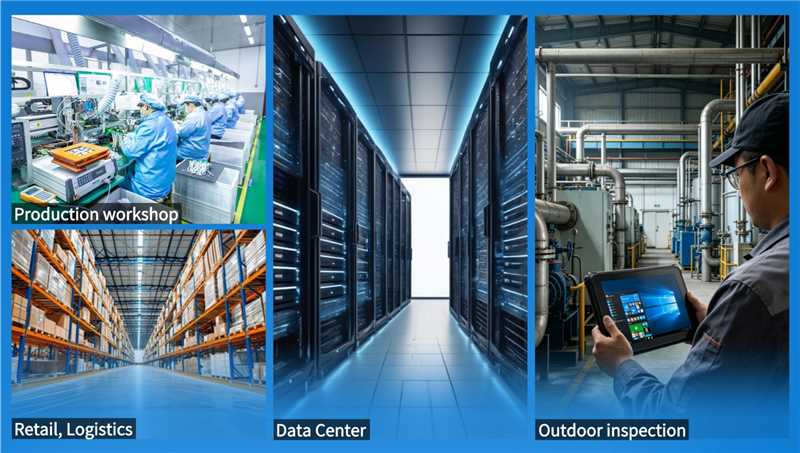
The core of industrial digital transformation is to use intelligent hardware to connect the whole link of data collection, interaction, transmission and processing. However, different scenarios have great differences in environmental characteristics and operation requirements, and the requirements for hardware are also completely different:
· Production workshops are in dusty and humid environments for a long time and need to run continuously for 24 hours, so hardware must have high protection and stability;
· Outdoor inspection scenarios face extreme temperature and collision risks, and the durability, battery life and positioning function of equipment are the core;
· Data centers pursue high-density deployment and remote management capabilities, and the scalability and reliability of hardware are crucial;
· Mobile operation scenarios in retail and logistics pay more attention to portability and data collection efficiency.
(Ⅰ) Production Workshop: Dual Support for Human-Computer Interaction and Core Control
The production workshop is the core scenario of intelligent manufacturing, which mainly needs two types of intelligent hardware:
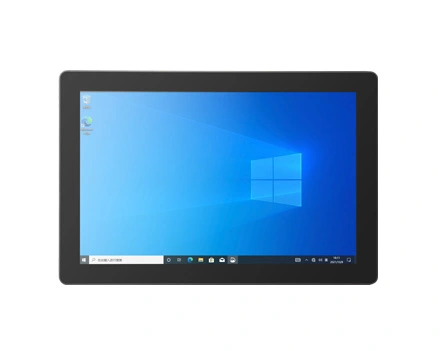
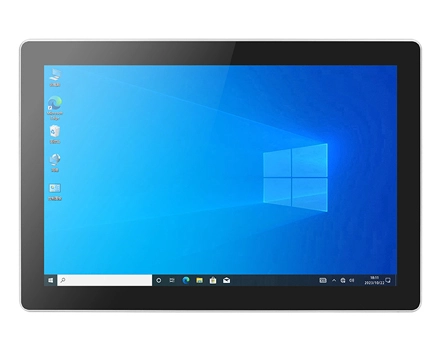
One is the panel PC for human-computer interaction. It needs to have IP65 front panel protection to resist dust and water stains in the workshop, and supports embedded or wall-mounted installation to save space. The multi-size touch screen of 10.1-32 inches can adapt to control needs of different scales. The configuration compatible with ARM and Intel multi-series CPUs can match tasks from simple equipment control to complex data processing, and can also expand 4G/5G modules to realize real-time data transmission.
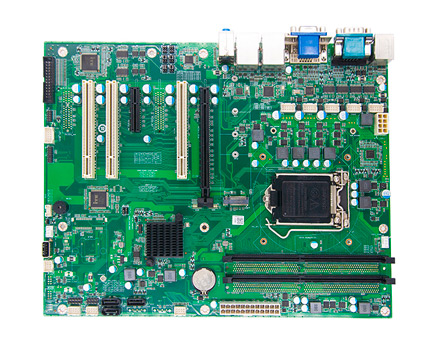
The other is the fanless industrial PC as the "invisible brain" of the equipment. The all-aluminum shell heat dissipation design can achieve silent operation to avoid interfering with workshop production. The stability of MTBF exceeding 50,000 hours ensures uninterrupted operation throughout the year. The PCIe/mini-PCIe slot supports expanding independent graphics cards or capture cards to meet the core computing needs of automated production lines.
(Ⅱ) Outdoor Operations: Ultimate Combination of Durability and Mobility
Outdoor scenarios such as logistics warehousing and power inspection have strict requirements on hardware durability, and rugged tablets are the optimal solution for such scenarios: military-grade features such as IP65/IP67 waterproof and dustproof, 1.2-meter drop resistance can cope with emergencies such as rainy days and collisions; detachable hot-swappable batteries can achieve 12 hours of long battery life to meet all-day outdoor operations; integrated Beidou/GPS dual positioning, NFC and QR code scanning functions can efficiently complete tasks such as cargo inventory and equipment inspection. Multi-series CPU configurations can also match different data processing needs.
(Ⅲ) Data Centers and Mobile Retail: Precise Adaptation of Professional Hardware
Data centers need high-density and high-reliability rackmount PCs. The 1U/2U/4U rack design can maximize space utilization. Redundant power supplies and RAID disk arrays ensure data security. The IPMI remote control module can realize real-time monitoring of hardware status and fault alarm to ensure stable operation of data centers 24/7. Mobile operation scenarios in retail and express delivery rely on handheld terminal PDAs. The 5.5-inch portable body is suitable for one-handed operation. The 2D barcode scanner with 3 scans per second and 99.9% accuracy can quickly complete commodity inventory and express scanning; 4G full network coverage + WiFi 6 ensures real-time data upload in remote areas, and the 5000mAh fast-charging battery can support all-day operations.
.jpg "Unlocking_Digital_Codes_for_Different_Scenarios_(2).jpg")
Many enterprises easily fall into the misunderstanding of "parameter-only theory" when selecting products, blindly pursuing high configuration but ignoring scenario adaptability, which instead causes cost waste or equipment failure. The correct selection logic should follow three principles:
Scenario Priority: First clarify the core needs of the scenario. For example, outdoor scenarios give priority to protection level and battery life, while production workshops pay attention to stability and scalability, rather than simply comparing CPU performance or screen size;
Compatibility is King: Confirm whether the hardware interface is compatible with existing equipment, such as whether the panel PC supports data collection of PLC and sensors, and whether the rackmount PC is compatible with the rack and power system of the data center;
Whole Life Cycle Consideration: In addition to the hardware itself, attention should also be paid to services such as after-sales response speed and customization capabilities, such as whether 2-hour after-sales response is supported, and whether appearance and performance can be customized on demand. These factors directly affect the long-term use cost of the equipment.
Industrial intelligent hardware is not a general-purpose tool, but a digital carrier customized for different scenarios. Only by accurately matching scenario requirements can it truly exert its value and lay a solid hardware foundation for industrial digital transformation.
Shenzhen Geshem Technology Co., Ltd. is a national high-tech enterprise with thirteen years of experience in the industry. It focuses on the research, design, intelligent manufacturing and sales services of industrial computers, industrial tablet PCs and rugged tablet PCs, and has been granted 92 patents (including 27 invention patents).