English
 français
 Deutsch
 Español
 italiano
 русский
 português
 中文
中文
×
In smart manufacturing and industrial automation, equipment must operate reliably for long periods to ensure production efficiency and system stability. Unlike commercial PCs, industrial computers are designed for harsh environments and can support 24/7 continuous operation under conditions such as extreme temperatures, vibration, and dust.
So, what enables industrial computers to run continuously and reliably? This article explores the key technologies behind their performance, including industrial-grade components, thermal management, wide-temperature design, and reliability optimization.
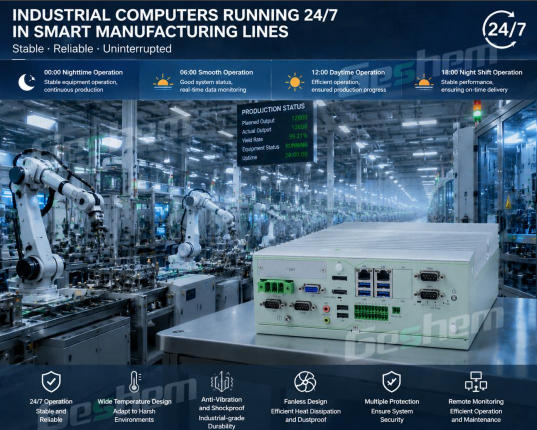
manufacturing, automation, energy management, transportation control, and other industrial applications, equipment is required to operate continuously for long periods. Unlike commercial PCs designed for daily office use, industrial computers are engineered for 24/7 continuous operation in demanding environments.
They are designed to handle not only high-performance computing tasks but also harsh conditions such as extreme temperatures, dust, vibration, and electromagnetic interference. Their reliability comes from industrial-grade hardware design, optimized system architecture, and rigorous testing.
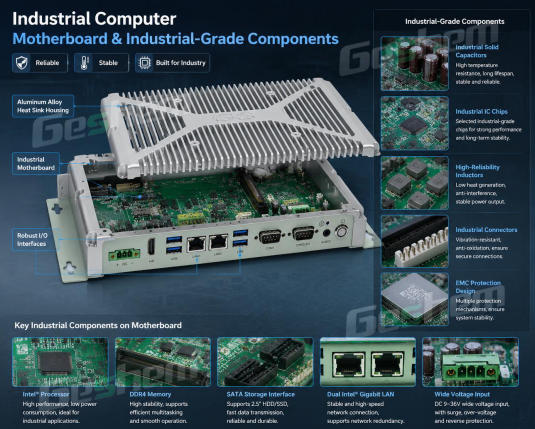
Industrial computers use carefully selected industrial-grade components, including:
· Industrial motherboards
· High-reliability capacitors
· Wide-temperature electronic components
· Long-life processor platforms
Compared with consumer-grade hardware, industrial components provide better durability and stability, reducing the risk of failures during continuous operation.
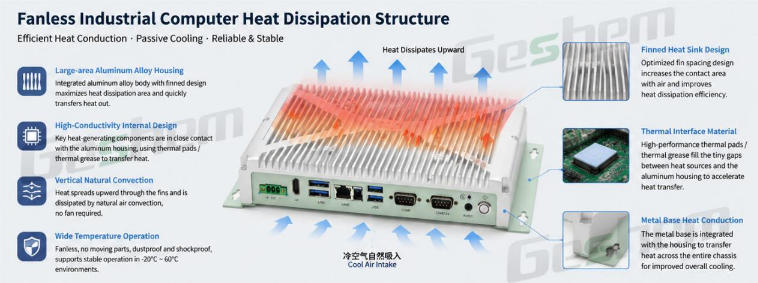
One of the biggest challenges of continuous operation is heat management.
Industrial computers often feature:
· Fanless cooling systems
· Aluminum alloy chassis
· Large-area heat dissipation structures
· High-performance thermal materials
Fanless designs eliminate mechanical fan failures and prevent dust accumulation inside the system, improving reliability in harsh industrial environments.
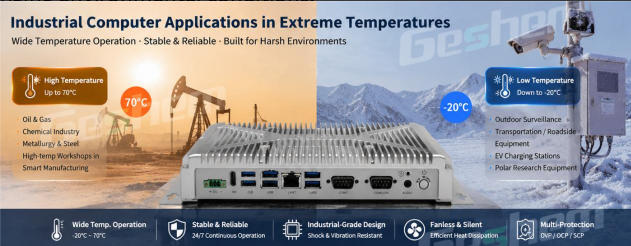
Industrial environments often experience significant temperature fluctuations, including:
· Outdoor terminals
· Automated production lines
· Cold chain logistics systems
· Energy monitoring equipment
Industrial computers are commonly designed to operate within extended temperature ranges, such as:-20°C to 60°C or even wider ranges.
Through specialized component selection and structural optimization, they maintain stable performance under changing environmental conditions.
Industrial equipment is often installed on machines, vehicles, or production lines where continuous vibration occurs.
Industrial computers improve reliability through:Rugged chassis structures,Secure cable designs,Industrial SSD storage and shock-resistant mounting solutions;These technologies minimize hardware damage caused by vibration and extend product lifespan.
Industrial environments require connections with various devices, including:PLC controllers ,Sensors,Barcode scanners,Cameras,Industrial network equipment
Industrial computers provide multiple I/O options such as:COM ports,USB ports,LAN interfaces,GPIO connections;allowing flexible integration for different industrial applications.
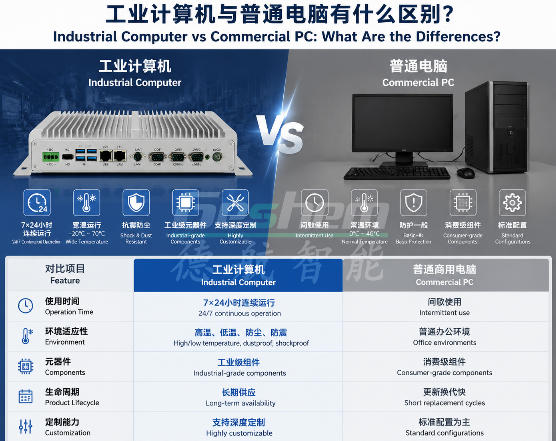
The ability of industrial computers to operate 24/7 does not simply come from powerful processors. It is the result of:
· Industrial-grade hardware selection
· Efficient thermal design
· Wide-temperature capability
· Rugged and interference-resistant structures
· Long-term product support
Together, these technologies ensure stable operation in demanding industrial environments.
For smart manufacturing, automation control, and industrial digitalization projects that require long-term reliability, choosing the right industrial computer is a key step toward improving efficiency and reducing maintenance costs.
Shenzhen Geshem Technology Co., Ltd. is a national high-tech enterprise with thirteen years of deep industry experience, specializing in the R&D, design, intelligent manufacturing, and sales of industrial computers, industrial panel PCs, and rugged tablets; the company holds a total of 92 authorized patents (including 27 invention patents).