English
 français
 Deutsch
 Español
 italiano
 русский
 português
 中文
中文
×
Industrial computing terminology exists for a reason. Whether you are an automation engineer specifying hardware for a new production line, a purchasing manager evaluating vendor technical documentation, or a plant operations lead troubleshooting field equipment, the terms and certifications you encounter are not mere marketing jargon. They define the operational boundaries of hardware within real-world industrial environments.
Geshem has observed that procurement delays and field failures—stemming from misunderstandings of technical terminology—occur more frequently than issues caused by any single component defect.
This article aims to clarify the key standards and certifications that warrant the closest attention when selecting or deploying industrial computing hardware. The objective is not to compile an encyclopedic catalog, but rather to equip you with a practical working vocabulary—enabling you to confidently interpret technical specifications, clearly articulate your requirements, and avoid common pitfalls during the equipment selection process.
Ingress Protection ratings, commonly known as IP ratings, are defined by the IEC standard 60529. They describe the degree of protection an enclosure provides against solid objects and liquids.
The rating format is IPXX, where the first X indicates protection against solid objects and the second X indicates protection against liquids.
IP Protection Rating Quick Reference Table:
.jpg "Industrial_Computer_Terminology_(2).jpg")
A common misconception: IP67 does not imply IP69K. These are separate test conditions. A device rated IP67 has been tested for immersion, but that test does not verify performance under high-pressure steam or water jet conditions. If your application involves pressure washers or steam cleaning, you need IP69K, not just IP67.
When reviewing datasheets, check whether the IP rating applies to the entire unit or only to specific areas. Some manufacturers rate only the front panel while the rear and cable openings remain unprotected. GeshemTech specifies IP ratings for the complete enclosure, including all integrated I/O ports, to eliminate ambiguity.
MIL-STD-810, a U.S. Department of Defense standard now widely adopted in industrial settings. The standard covers a broad range of environmental factors, including:
Shock: High-intensity shock pulses simulating drop, handling, and transit damage
Vibration: Sinusoidal and random vibration across multiple axes, typically 5 to 2000 Hz
Temperature: Operational and survival temperature ranges, including rapid thermal cycling
Humidity: Extended exposure to high humidity environments
Altitude: Performance at low atmospheric pressure (relevant for aviation and high-altitude deployments)
For industrial computers, vibration and shock are the most critical parameters: factory floors have constant random vibration from machinery, while vehicle-mounted systems face repeated shocks from rough terrain.
MIL-STD-810 Vibration Test Categories vs. Industrial Environments: Comparison Table
.jpg "Industrial_Computer_Terminology_(3).jpg")
Note that MIL-STD-810 compliance alone does not guarantee suitability for a specific application. The standard defines test conditions, not pass/fail thresholds that are universally applicable. Always verify that the tested conditions match your operational environment rather than assuming a stated MIL-STD-810 compliance level means the equipment will perform adequately.
Understanding industrial bus architecture is fundamental when selecting I/O expansion modules, communication cards, and data acquisition hardware for industrial computers. The specific bus type directly determines the system's maximum bandwidth, real-time performance capabilities, and hardware compatibility—making it a critical metric during the hardware selection phase.
PCI and PCI-X are traditional parallel bus architectures: PCI, introduced in the 1990s, was once the dominant expansion solution for industrial equipment; standard specifications offered a bandwidth of 133 MB/s, while the upgraded PCI-X version could reach speeds of up to 1066 MB/s. Currently, most new industrial computers have eliminated native PCI slots; consequently, legacy PCI cards are now primarily utilized in retrofit projects for existing facilities, necessitating prior verification of either native motherboard support or the availability of suitable adapter solutions. PCIe represents the current universal industry standard: employing a point-to-point channel architecture, the Gen4 version offers a bidirectional bandwidth of up to 1.97 GB/s per lane. Different lane configurations are tailored to specific applications: x1 slots suit low-speed peripherals; x4 slots accommodate medium-bandwidth data acquisition or multi-port network cards; x8 slots support GPUs or high-channel-count acquisition systems; and x16 slots are designed for AI accelerators or high-end graphics cards. For real-time control applications, it is essential to verify support for PCIe timing isolation or Time-Sensitive Networking (TSN) features to minimize latency jitter. VPX is designed for demanding environments—such as military and aerospace applications—offering exceptional shock resistance and wide-temperature operational capabilities; it is ideally suited for radar processing and high-end machine vision systems requiring multi-module coordination. COM Express is a modular bus standard that decouples the core computing unit from the carrier board; this allows for computing power upgrades without the need to redesign the carrier board, making it ideal for industrial projects with long product lifecycles. The mainstream categories include the general-purpose Type 6, the network- and storage-optimized Type 7, and the compact Type 10.
Explosion-proof certifications are mandatory for electronic equipment deployed in environments where flammable gases, vapors, or dusts are present. Two standards dominate the global market: ATEX for the European Economic Area and IECEx for international use.
(Ⅰ)ATEX Directive 2014/34/EU
ATEX derives its name from the French "Atmosphères Explosibles." The ATEX directive regulates equipment intended for use in potentially explosive atmospheres within the European Economic Area. Equipment must be certified by a Notified Body before being placed on the market.
The ATEX certification uses two parameter groups:
Group I: Mining applications (methane and coal dust environments)
Group II: Surface industries (all other explosive atmospheres)
For Group II equipment, the certification further classifies zones based on the likelihood of explosive atmospheres:
ATEX Zone Classification Table:
.jpg "Industrial_Computer_Terminology_(4).jpg")
ATEX also classifies equipment into temperature classes (T1 through T6) based on the maximum surface temperature the equipment can generate, ensuring it stays below the ignition temperature of the surrounding atmosphere.
(Ⅱ)IECEx Certification
IECEx is the International Electrotechnical Commission's certification system for equipment used in explosive atmospheres. It is designed to facilitate international trade by providing a single certification scheme accepted across multiple countries.
IECEx certification follows the IEC 60079 series of standards, which cover:
IEC 60079-0: General requirements
IEC 60079-1: Explosion-proof enclosures ("d" protection)
IEC 60079-2: Pressurized enclosures ("p" protection)
IEC 60079-7: Increased safety ("e" protection)
IEC 60079-11: Intrinsic safety ("i" protection)
IEC 60079-31: Dust ignition protection ("t" protection)
For industrial computer procurement in hazardous locations, always confirm that the certification scope covers the specific zone, gas group, and temperature class of your application. A device certified for Zone 2 gas environments may not be approved for Zone 1 or Zone 0 use.
The corrosive challenges posed by marine and coastal environments far exceed those of typical outdoor settings, as salt spray, high humidity, and UV radiation accelerate equipment aging.
Salt spray testing (ASTM B117) serves as a critical performance benchmark: while standard outdoor industrial equipment is required to pass a 500-hour test, marine-grade equipment demands a minimum of 1,000 hours. GeshemTech’s marine product series not only successfully passes the 1,000-hour salt spray test but also undergoes comprehensive functional verification post-testing to ensure that internal components and connectors remain free from corrosion. Furthermore, the C5-M coating classification under the ISO 12944 standard represents the gold standard for marine equipment, mandating a coating system capable of long-term resistance against saltwater erosion. Concurrently, equipment compliant with IPC Class 3 assembly standards demonstrates superior soldering quality and component reliability, thereby significantly extending its operational lifespan in corrosive environments.
Certain industrial environments generate strong electromagnetic fields that can disrupt standard computing hardware. MRI suites, large electric motors, transformers, and induction heating equipment create field strengths that interfere with standard magnetic storage media, affect display quality on non-shielded monitors, and can induce currents in unshielded cables.
(Ⅰ)Magnetic Field Immunity Standards
There is no single universally-applied standard for magnetic field immunity in industrial computers. However, relevant test standards include:
IEC 61000-4-8: Immunity to power-frequency magnetic fields — tests equipment at 50/60 Hz field strengths up to 100 A/m
IEC 61000-4-9: Immunity to pulsed magnetic fields — simulates fields from lightning strikes and switching transients
For deployment near MRI equipment or large industrial magnets, custom magnetic shielding solutions are typically required in addition to standard commercial immunity certifications. The shielding involves mu-metal enclosures and cable shielding that add both cost and weight to the system.
(Ⅱ)Vibration Standards for Industrial Equipment
Beyond MIL-STD-810, several industrial-specific vibration standards define test and performance criteria:
IEC 60068-2-6: Vibration (sinusoidal) testing for equipment
IEC 60068-2-27: Shock testing for equipment
IEC 60068-2-64: Vibration (broadband random) testing for equipment
Industrial Equipment Vibration Levels (IEC 60721) Table:
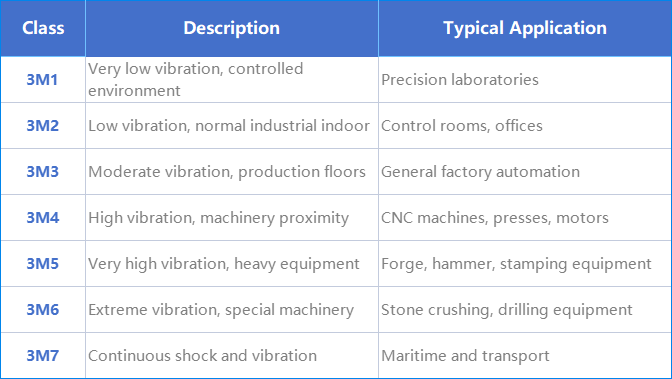
Selecting hardware that meets or exceeds the vibration class of your deployment environment prevents premature mechanical failure of hard disk drives, connectors, and enclosure mounting systems.
Understanding industrial computer terminology is not an academic exercise. It directly impacts three practical outcomes in your operations:
Correct equipment specification: When you know the difference between IP65 and IP67, or between ATEX Zone 1 and Zone 2, you avoid the costly mistake of specifying under-rated hardware for an application where the consequences of failure are severe.
Accurate supplier communication: Sharing a datasheet that references the correct standards and certifications eliminates ambiguity. A supplier who receives an RFQ citing IEC 60079-11 intrinsic safety requirements understands the technical scope of the project immediately, reducing back-and-forth clarification cycles.
Reduced field failures: Equipment rated for the actual environmental conditions of your deployment survives longer. This is not just about ruggedized hardware costing more upfront. In facilities where downtime carries significant production cost, a 20% increase in hardware cost that prevents a single unplanned production stop typically pays for itself many times over.
GeshemTech industrial computers and rugged tablet systems are engineered to meet or exceed the standards described in this article. Our engineering team can help translate your operational environment into specific hardware requirements and configuration options.
For application-specific technical discussions or custom certification requirements, reach out to our product engineering group through your standard GeshemTech contact channel.