English
 français
 Deutsch
 Español
 italiano
 русский
 português
 中文
中文
×
In today's rapidly evolving industrial landscape, the choice of an industrial computer (IPC) is far more than a simple hardware procurement decision. It is a strategic investment that directly impacts system reliability, operational efficiency, total cost of ownership, and ultimately, your bottom line. Unlike commercial-grade PCs, industrial computers are engineered to thrive in demanding environments where factors like dust, moisture, vibration, extreme temperatures, and continuous operation would cripple standard equipment.
Selecting the wrong IPC can lead to frequent downtime, data loss, safety hazards, and costly replacements. Conversely, the right choice becomes a robust, silent partner in your automation journey. This guide is designed to equip engineers, system integrators, and procurement professionals with a structured framework for making an informed selection, ensuring your investment delivers maximum value and performance.
The first step in selection is identifying the most suitable form factor for your application's physical and integration requirements. Each type offers distinct advantages.
(Ⅰ)Panel PC / Industrial Touchscreen Computer
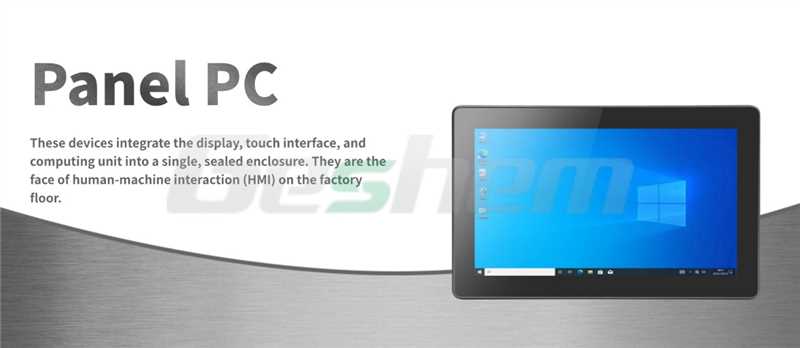
Best For: Operator stations, control panels, machine HMIs, kiosks.
Key Considerations: Screen size (typically 10" to 24"), resolution, touch technology (resistive, projective capacitive for gloved hands), front panel IP rating (IP65 is common for dust and water jet protection), and brightness (nits) for sunlight-readable applications.
(Ⅱ)Box PC / Embedded Industrial Computer
.jpg "The_Definitive_Guide_to_Selecting_the_Right_Industrial_Computer_for_Your_Application_(3).jpg")
Best For: Machine vision systems, IoT gateways, edge computing nodes, compact control cabinets, in-vehicle computing.
Key Considerations: Processor performance, number and type of ports (LAN, COM, USB, GPIO), expansion capabilities (PCIe slots), mounting options, and passive cooling design for silent, maintenance-free operation in dusty areas.
(Ⅲ)Rugged Tablet Computer
.jpg "The_Definitive_Guide_to_Selecting_the_Right_Industrial_Computer_for_Your_Application_(4).jpg")
Best For: Warehouse management, field service, logistics, outdoor asset tracking, plant floor mobility.
Key Considerations: Ruggedness certifications (MIL-STD-810G for shock/vibe, IP67 for immersion), battery life, daylight-readable displays, integrated barcode/RFID scanners, and wireless options (Wi-Fi 6, 4G/5G, GNSS).
(Ⅳ)Rackmount Industrial Server
.jpg "The_Definitive_Guide_to_Selecting_the_Right_Industrial_Computer_for_Your_Application_(5).jpg")
Best For: SCADA servers, manufacturing execution systems (MES), data historians, virtualization hosts.
Key Considerations: Rack unit height (1U, 2U, 4U), processor core count and redundancy, hot-swappable drives and power supplies, remote management capabilities (IPMI), and network interface density.
Once the form factor is narrowed down, deep dive into the technical specs that ensure compatibility and longevity.
(Ⅰ)Processor & Performance
Balance processing needs with power consumption and thermal design.
· Entry-Level (Atom/Celeron): Suitable for basic HMI, simple data logging, and gateway functions.
· Mid-Range (Core i3/i5): The workhorse for most automation tasks, PLC supervision, and multi-tasking HMIs.
· High-Performance (Core i7/i9, Xeon, AMD Ryzen V2000): Essential for machine vision, advanced analytics, digital twins, and edge AI inference.
(Ⅱ)Memory & Storage
Opt for industrial-grade components with wider temperature tolerances.
· RAM: 8GB is a common baseline; 16GB or more is recommended for data-intensive tasks. Error-Correcting Code (ECC) memory is critical for server applications to prevent data corruption.
· Storage: Solid State Drives (SSDs) are mandatory for vibration resistance. Consider SATA SSDs for cost-effectiveness or NVMe drives for ultra-high speed. For high reliability, look for models with RAID support (RAID 1 mirroring or RAID 5 parity).
(Ⅲ)Environmental Durability
This is what separates industrial computers from their commercial counterparts.
· Operating Temperature: Standard industrial range is 0°C to 60°C. Extended ranges (e.g., -20°C to 70°C) are available for outdoor or unheated environments.
· Ingress Protection (IP Rating): IP65 signifies dust-tight and protected against low-pressure water jets, ideal for wash-down areas. IP67 adds protection against temporary immersion.
· Shock & Vibration Resistance: Certified to withstand the constant vibrations of heavy machinery and potential impacts. MIL-STD-810G testing is a recognized benchmark.
· Power Supply: Wide-range DC input (e.g., 9~36VDC) is crucial for vehicle-mounted or unstable power grid applications. Redundant AC/DC power supplies are vital for mission-critical servers.
(Ⅳ)Certifications & Compliance
Certifications are not just stickers; they are proof of rigorous testing and compliance with international safety and quality standards.
· Safety: CE marking, FCC, UL/cUL.
· EMC: Ensures the device neither emits disruptive interference nor is susceptible to it, crucial for stable operation in electrically noisy plants.
· Industry-Specific: Marine, railway, medical. Companies like Geshem design products to meet these global standards, facilitating market entry.
(Ⅰ)I/O Ports & Expansion
Match the IPC's connectivity to your legacy and modern devices.
Essential Ports: Multiple Gigabit LAN ports, USB 3.0+, serial COM ports (RS-232/422/485 for PLCs and sensors).
Expansion Slots: PCI or PCIe slots allow for adding frame grabbers (vision), motion control cards, or specialized communication modules.
Wireless: Integrated Wi-Fi, Bluetooth, and cellular modems enable flexible deployment and IIoT connectivity.
(Ⅱ)Software & OS Compatibility
Ensure compatibility with your chosen operating system and industrial software stack (e.g., Siemens TIA Portal, Rockwell FactoryTalk, Ignition SCADA). Windows 10/11 IoT Enterprise is common for its long-term servicing channels. Linux distributions are popular for embedded and gateway applications.
(Ⅲ)Lifecycle & Service
Industrial projects have lifespans of 5-15 years. Choose a supplier committed to:
Long-Term Availability: Guaranteed product availability for 5+ years.
Scalable Solutions: Ability to provide custom modifications (ODM services) for unique requirements.
Global Support: Accessible technical support and service network, especially important for multinational operations.
To synthesize the above factors, use the following matrix as a starting point for your evaluation.
Quick Reference Guide Table for Industrial PC Selection:
(1).jpg "The_Definitive_Guide_to_Selecting_the_Right_Industrial_Computer_for_Your_Application_(6)(1).jpg")
Other considerations refer to the guide table:
(1).jpg "The_Definitive_Guide_to_Selecting_the_Right_Industrial_Computer_for_Your_Application_(7)(1).jpg")
Selecting the right industrial computer is a systematic process that aligns technical capabilities with operational realities. Begin by defining the environmental challenges and physical constraints of your application. Then, meticulously evaluate the computing performance, durability specifications, and necessary connectivity. Finally, choose a reputable supplier.
Shenzhen Geshem Technology Co., Ltd. is a national high-tech enterprise with thirteen years of experience in the industry. It focuses on the research, design, intelligent manufacturing and sales services of industrial computers, industrial tablet PCs and rugged tablet PCs, and has been granted 92 patents (including 27 invention patents).