English
 français
 Deutsch
 Español
 italiano
 русский
 português
 中文
中文
×
Ruggedized tablet computers, often referred to as reinforced or hardened tablet devices, represent specialized mobile computing solutions engineered to operate reliably under extreme conditions where consumer-grade tablets would fail. These devices incorporate advanced reinforcement methodologies to enhance structural integrity, environmental resilience, and operational longevity. This article examines the key reinforcement techniques applied to tablet computers and explores their professional applications across diverse industrial sectors.
Reinforcement in tablet computers primarily focuses on physical hardening, thermal management, and system-level protections. Manufacturers employ several established methodologies:
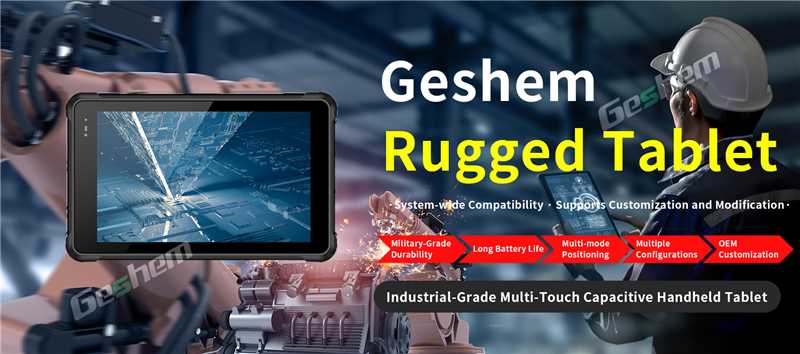
Structural Reinforcement: The enclosure utilizes reinforced materials such as magnesium alloy or polycarbonate composites with rubberized bumpers. Drop resistance is achieved through multi-layer shock absorption designs, typically tested to MIL-STD-810H standards, allowing survival from drops of 1.5–2 meters onto concrete surfaces. Impact-resistant Gorilla Glass or chemically strengthened glass protects the touchscreen.18
Environmental Sealing: IP65 or IP67 ingress protection ratings ensure dust-tight construction and resistance to water immersion. Sealed ports, gaskets, and conformal coatings on internal circuitry prevent ingress of dust, moisture, chemicals, and particulates. This is critical for deployment in dusty warehouses or outdoor field operations.
Thermal and Vibration Hardening: Fanless designs with large-surface aluminum heat sinks or heat pipes maintain operational stability across wide temperature ranges (−20°C to +60°C or broader). Vibration dampening mounts and reinforced internal chassis mitigate mechanical stress in vehicle-mounted or mobile scenarios.
Software and System Reinforcement: Beyond hardware, system hardening includes secure boot processes, encrypted storage, over-the-air (OTA) firmware updates with rollback capabilities, and ruggedized operating systems optimized for Android or Windows environments. These measures prevent crashes, enhance cybersecurity, and support hot-swappable batteries for uninterrupted field use.22
These techniques collectively transform standard tablet architectures into durable platforms capable of sustaining continuous operation in harsh environments.
Ruggedized tablet computers find extensive deployment in sectors demanding mobility combined with high reliability:
.jpg "reinforcement-techniques-and-applications-of-ruggedized-tablet-computers-in-industrial-environments_(2).jpg")
Construction and Field Service: Project managers utilize reinforced tablets for real-time data entry, blueprint viewing, and progress reporting on-site. Integrated GPS, barcode scanning, and 4G/5G connectivity enable seamless workflow integration, reducing paperwork and improving accuracy under variable weather conditions.28
Logistics and Warehousing: In high-throughput environments, these devices support inventory management, order fulfillment, and forklift-mounted operations. Their vibration and drop resistance ensure uninterrupted performance during constant movement.
Manufacturing and Industrial Automation: Operators employ rugged tablets for machine interfacing, quality control inspections, and augmented reality (AR) maintenance guidance. Integration with enterprise resource planning (ERP) systems facilitates on-floor decision-making.
Public Safety, Utilities, and Military: First responders and utility technicians rely on these devices for situational awareness, computer-aided dispatch (CAD), and remote diagnostics. Military-grade certifications guarantee functionality in extreme climates and under physical stress.31
Healthcare and Transportation: Mobile clinical documentation and fleet management applications benefit from the devices’ long battery life and disinfection-resistant surfaces.
In each domain, the reinforcement enables a transition from paper-based or stationary computing to fully mobile, real-time digital workflows, significantly enhancing productivity and reducing downtime.
The primary advantages of reinforced tablet applications include extended mean time between failures (MTBF), lower total cost of ownership through reduced replacement rates, and improved worker safety via reliable data access. However, selection must consider specific certifications (e.g., ATEX for explosive atmospheres), battery endurance, and compatibility with enterprise software ecosystems.
Future developments are expected to incorporate 5G integration, edge AI processing, and further advancements in lightweight composite materials, further expanding the scope of ruggedized tablet deployments.
In conclusion, the systematic application of reinforcement techniques to tablet computers has established them as indispensable tools in professional and industrial contexts. By addressing the limitations of conventional devices, these ruggedized solutions deliver robust performance where reliability is paramount.