English
 français
 Deutsch
 Español
 italiano
 русский
 português
 中文
中文
×
The factory floor has changed. Where decisions once moved through layers of hierarchy—from sensor to supervisor, from floor to boardroom—a new model is taking hold. Edge computing puts intelligence directly at the point of action, enabling machines to respond to events in milliseconds rather than minutes. For manufacturers pursuing smart production, this shift is not optional. It is the foundation.
This article examines how edge computing integrates with smart manufacturing ecosystems, what industrial operators should evaluate when deploying edge infrastructure, and how solutions from Geshem Industrial address the demands of real-world production environments.
Edge computing refers to processing data near its source—at the "edge" of a network—rather than transmitting everything to a centralized cloud server. In manufacturing, the edge typically lives at the machine level: a programmable logic controller (PLC), a vision inspection station, a robotic welding arm. By processing data locally, edge systems reduce latency, conserve bandwidth, and allow critical operations to continue even when connectivity is interrupted.
A traditional cloud-dependent architecture sends every sensor reading to a remote data center for analysis. If a weld seam deviates by 0.3 millimeters on a automotive assembly line, that data travels to the cloud, gets analyzed, and a corrective signal returns—potentially 200 to 500 milliseconds later. On a high-speed production line, that delay translates directly into scrap parts and rework costs.
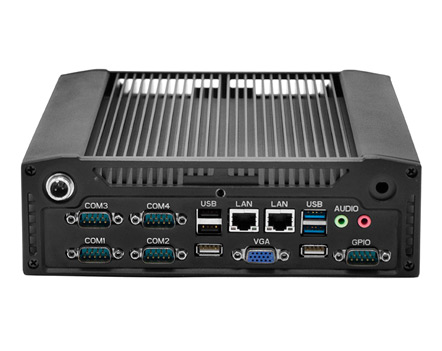
An edge architecture handles the same event locally. The Geshem embedded PC attached to the welding station evaluates the deviation, issues the corrective command, and logs the event. All within 5 to 20 milliseconds. The cloud receives a summary record for long-term analysis, not the raw stream.
This distinction matters across every industry vertical where Geshem industrial computers and rugged tablets operate: automotive, semiconductor, food and beverage, pharmaceuticals, and logistics.
Edge computing is not a single technology—it manifests differently depending on the production context. The following represent the highest-value deployment scenarios.
(Ⅰ)Machine Vision and Quality Inspection
High-resolution cameras mounted at inspection stations generate continuous image streams. A Geshem rugged tablet or panel PC running a trained defect detection model evaluates each part in real time. Common deployments achieve 99.4% to 99.9% defect detection rates at line speeds that exceed 60 parts per minute. The edge device triggers rejection mechanisms immediately, before defective parts enter downstream assembly.
(Ⅱ)Predictive Maintenance
Vibration sensors, acoustic emission detectors, and thermal cameras feed edge nodes continuously. Geshem embedded computing solutions run anomaly detection models that identify deviations from baseline machine behavior—patterns that predict bearing wear, coolant degradation, or spindle misalignment weeks before catastrophic failure. One automotive parts manufacturer reported a 34% reduction in unplanned downtime after deploying edge-based predictive maintenance across critical machining centers.
(Ⅲ)Automated Guided Vehicles (AGV) and Autonomous Mobile Robots (AMR)
Navigation systems on factory logistics robots require real-time sensor fusion—combining LiDAR, odometry, and proximity data to make steering decisions at 50 to 100 hertz. Edge computing nodes from Geshem Industrial handle this locally, eliminating the latency risk of cloud-based navigation. The Geshem rugged tablet series, rated for vibration and dust, suits mobile robot deployments in harsh manufacturing environments.
(Ⅳ)Process Optimization and Digital Twin Synchronization
Edge nodes collect and pre-process operational data, maintaining a local digital representation of machine state. These edge-level digital twins synchronize with plant-wide digital twin platforms at scheduled intervals. This hybrid architecture provides both the real-time fidelity needed for local control and the broader optimization view provided by enterprise analytics.
Choosing the right edge architecture depends on scale, criticality, and integration complexity. The following framework helps manufacturers evaluate deployment options.
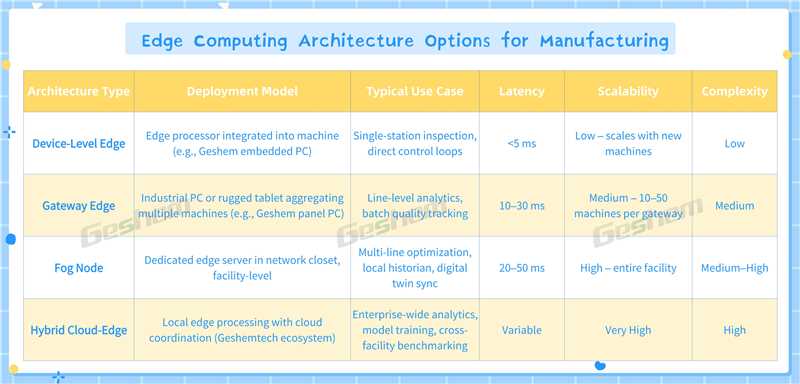
For most smart manufacturing initiatives, a phased approach works best: start with device-level edge on the highest-value production cells, layer in gateway-level aggregation, then deploy fog nodes for facility-wide optimization. Geshem Industrial offers products aligned to each tier.
Before deploying edge infrastructure, industrial operators should address several factors that determine long-term success.
(Ⅰ)Environmental Hardening
Factory floors present thermal, vibration, electrical, and particulate challenges that consumer-grade hardware cannot withstand. Geshem industrial computers and rugged tablets are engineered for these conditions: wide operating temperature ranges (-40°C to +75°C), MIL-STD-810G vibration and shock ratings, IP65 to IP67 ingress protection, and fanless thermal designs that eliminate moving parts.
(Ⅱ)Integration with Existing PLC and SCADA Infrastructure
Edge nodes do not replace existing control systems—they complement them. Geshem panel PCs and embedded PCs support standard industrial protocols including OPC-UA, Modbus TCP, PROFINET, and EtherNet/IP. This interoperability allows edge analytics to consume data from legacy PLCs without requiring control system modifications.
(Ⅲ)Model Deployment and Updating
Machine learning models at the edge require periodic retraining as product specifications change, machines age, and new defect patterns emerge. Geshem edge platforms support containerized model deployment, allowing engineering teams to push updated inference models to production edge nodes via OTA (over-the-air) updates without halting operations.
(Ⅳ)Power and Mounting Flexibility
Edge computing nodes should be deployable in DIN-rail, wall-mount, or VESA configurations depending on available space. Geshem Industrial provides multiple form factors, including compact embedded PCs that fit inside electrical cabinets alongside existing control equipment. Power consumption also matters at scale: a 15-watt Geshem embedded PC operated continuously across 100 machines adds 36 kilowatt-hours per day to facility load—a manageable figure, but one that planning teams should incorporate.
Choosing an edge computing vendor for a manufacturing environment is not a commoditized decision. Hardware must operate where consumer electronics cannot, integrate decades-old industrial protocols, and reliably operate throughout the typical 7-15 year lifespan of manufacturing equipment.
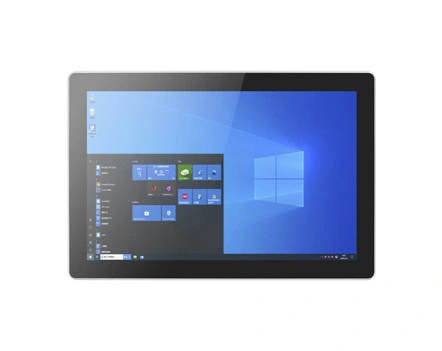
Geshem builds edge computing hardware specifically for industrial deployments. Geshem's rugged tablet series combines fanless computing, a capacitive touchscreen, and IP67 sealing, making it suitable for deployments in production lines, quality labs, and logistics operations. Geshem's embedded PC series offers high compute density processing in a compact rail-mount form factor and is designed for electrical cabinet mounting. Geshem tablets provide integrated HMI and edge computing capabilities, replacing traditional SCADA terminals with systems capable of human-machine interaction and local inference.
Shenzhen Geshem Technology Co., Ltd. is a national high-tech enterprise with thirteen years of experience in the industry. It focuses on the research, design, intelligent manufacturing and sales services of industrial computers, industrial tablet PCs and rugged tablet PCs, and has been granted 92 patents (including 27 invention patents).