English
 français
 Deutsch
 Español
 italiano
 русский
 português
 中文
中文
×
For the better part of a decade, manufacturers chased the promise of cloud computing. Upload everything. Analyze everything. Decide everything in a data center hundreds of miles away. The logic was sound on paper — centralized resources, elastic scaling, lower upfront costs. But factory floors don't operate on paper.
Latency kills. A CNC machine tool generating 10,000 data points per second cannot wait 200 milliseconds for a cloud server to process an anomaly and send back an alarm. By the time that signal returns, the tool has already gouged the workpiece. Scrap rates climb. Downtime follows.
Edge computing changes the equation. By placing processing power where the data originates — on the factory floor, inside the cabinet, alongside the conveyor — decisions happen in milliseconds, not hundreds of milliseconds. The industrial computer, once a dumb terminal feeding data upstream, becomes the brain of the operation.
Meeting Real-time Control Requirements: The manufacturing sector places extremely high demands on production timing. Welding robots require sub-millisecond coordination, and visual inspection systems must complete defect classification within a single production cycle; latency and jitter in cloud-based data transmission can render closed-loop control unreliable. By executing inference locally at the edge, defect detection takes just 5 milliseconds—dozens of times faster than the 50–300 millisecond response time typical of cloud-based systems—enabling the timely interception of defective products.
Drastically Reducing Bandwidth Costs: A single production line equipped with sensors and vision systems generates 2–5 TB of raw data daily; uploading this entire volume to the cloud is both costly and prone to instability. Edge devices can first filter, aggregate, and compress this data, uploading only anomalies and relevant statistical information, thereby reducing bandwidth consumption by over 90%.
Ensuring Continuous and Stable Production: Factories cannot afford to halt production due to network outages. Edge devices are capable of autonomous operation when disconnected from the network, synchronizing data with the central system once connectivity is restored, thereby remaining unaffected by the stability of the underlying infrastructure.
Industrial PCs (IPCs): IPCs serve as the primary nodes for edge computing. Unlike standard office desktop computers, they are specifically engineered for continuous 24/7 operation in harsh industrial environments. Their fanless designs eliminate air intake vents—common entry points for airborne particulates. A wide operating temperature range (typically -20°C to 60°C) allows them to adapt to seasonal temperature fluctuations and proximity to heat-generating industrial processes.
Modern IPCs boast powerful processing capabilities. Platforms such as the Intel 12th/13th Gen Core and AMD Ryzen Embedded series deliver multi-core performance sufficient to simultaneously support real-time machine vision, predictive maintenance inference, and protocol conversion.
Industrial Panel PCs: Used for Human-Machine Interaction (HMI), Panel PCs integrate both display and computing functions into a single compact unit, designed for direct mounting onto machinery or operator workstations. Within an edge computing architecture, they fulfill a dual role: providing local data visualization while simultaneously performing edge processing tasks. A Panel PC installed on a packaging line, for instance, can run HMI applications, execute quality inspection algorithms using its integrated processor, and forward aggregated data to the Manufacturing Execution System (MES)—all accomplished by a single device. Ruggedized Panel PCs featuring an IP65-rated front panel are capable of withstanding the high-pressure wash-down environments commonly found in the food and pharmaceutical industries.
Embedded PCs: Designed for space-constrained deployments, Embedded PCs address situations where there is insufficient physical space at an edge node to accommodate a standard-sized Industrial PC (IPC). Embedded PCs—compact and typically palm-sized—are ideal for installation inside control cabinets, AGV chassis, and robotic arm bases. Despite their small footprint, they provide ample computing power for protocol gateway functions, local data logging, and lightweight inference tasks.
Geshem's line of embedded PCs exemplifies this category of devices, offering both Intel and ARM platforms in form factors compact enough to fit within standard DIN rail enclosures.
Designing an edge computing architecture for a factory requires deliberate layering. The three-tier model has become the de facto standard:
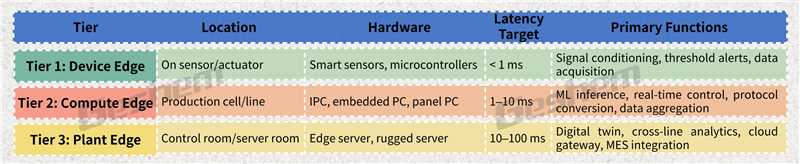
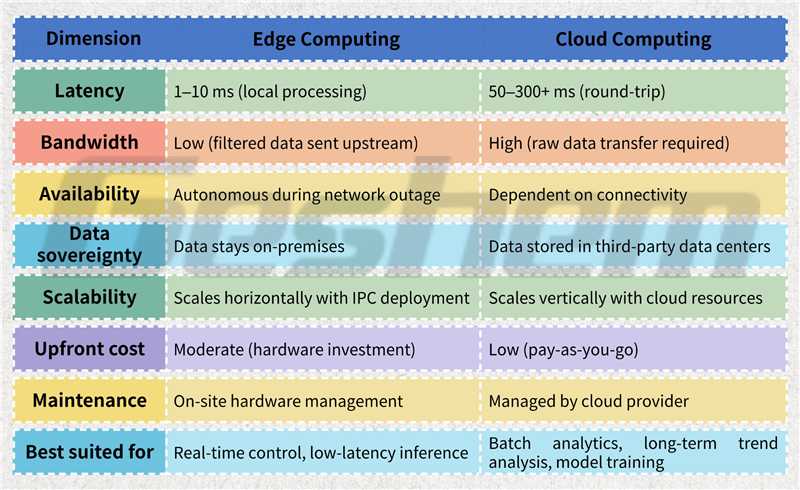
The reality is not edge versus cloud — it is edge and cloud. Smart manufacturing architectures use both: edge for real-time decisions and cloud for model training, long-term analytics, and cross-plant benchmarking.
(Ⅰ)Managing Edge Infrastructure at Scale
A single factory might deploy 50 to 200 edge nodes. Managing firmware updates, security patches, and configuration changes across all of them demands an edge management platform. Solutions based on MQTT brokers, Kubernetes edge extensions (K3s, KubeEdge), and vendor-specific device management suites provide centralized control over distributed hardware.
GeshemTech's industrial computing platforms are designed with remote manageability in mind, supporting out-of-band management and firmware over-the-air updates that minimize operator intervention.
(Ⅱ)Security at the Edge
Every edge node is a potential attack surface. Unlike cloud servers protected behind corporate firewalls, factory-floor IPCs sit in physically accessible locations. Security must be layered: encrypted storage, secure boot, network segmentation, and role-based access control. The IEC 62443 standard provides a comprehensive framework for industrial cybersecurity that applies directly to edge deployments.
(Ⅲ)Skill Gaps
Deploying and maintaining edge computing systems requires skills that blend IT and OT competencies. Many manufacturing organizations have deep OT expertise but limited experience with containerization, model deployment, and network security. Partnerships with industrial computing vendors who offer integration support can accelerate deployment and reduce risk.
(Ⅳ)The Road Ahead
Edge computing in manufacturing is moving toward greater autonomy. The next generation of industrial computers will support federated learning — models that improve themselves using local data without sending raw data to the cloud. AI accelerators built into IPCs will make real-time inference cheaper and more power-efficient. And 5G private networks will provide the low-latency backbone that connects edge nodes without the cabling constraints of wired Ethernet.
The factories that embrace edge computing today are building the foundation for autonomous operations tomorrow. The industrial PC is no longer just a terminal. It is the edge brain of smart manufacturing.
Edge computing has moved from concept to production on factory floors worldwide. Industrial PCs — whether full-size IPCs, panel PCs, or embedded units — provide the compute substrate that makes real-time intelligent manufacturing possible. By processing data where it is generated, edge architectures deliver the latency, bandwidth efficiency, and resilience that cloud-only approaches cannot match.
For manufacturers evaluating edge computing, the starting point is clear: identify the processes where latency directly impacts quality or throughput, deploy IPCs at the compute edge, and build incrementally. Edge computing is not a replacement for cloud analytics — it is the essential complement that makes smart manufacturing genuinely smart.